- Dylan's Public Journal
- Posts
- Ukrainian Sovereignty Under Threat
Ukrainian Sovereignty Under Threat
A personal account of my experience supporting Ukraine's fight against Russian aggression

Dylan Blaha
February 24, 2025
“What do we do if it starts tonight?” I asked Alejandro, as we packed away our belongings and walked towards the exit. We both jogged down multiple flights of stairs and through several sets of double doors, lost in thought.
“Honestly, I have no idea,” he replied. “Nobody’s put out any guidance.” He paused, while his mind seemed to continue racing. “I mean… is there anything we can do in the middle of the night?“
I shook my head. “No, you’re probably right. We’d just be staring at our screens, dumbfounded. I’m sure we can do that just as well at home.”
The date was February 23, 2022. Alejandro and I served as liaison officers at US Army Europe and Africa headquarters, which gave us a front row seat to the impending Russian invasion of Ukraine.

An unclassified map depicting Russian forces near Ukraine on 3 December 2021.
The Build Up
I arrived in Germany a few days after thanksgiving in 2021. After a few weeks of in-processing, car and apartment hunting, and even more in-processing, I sat down at my desk to finally learn my job.
During the few weeks prior to my arrival, I’d grown worried over whether I’d made a mistake in volunteering to mobilize to Germany. Would I get bored? Would I start to lose my mind, because I felt like my skills weren’t being properly utilized?
The first few meetings nearly knocked me out of my chair. What did I get myself into? At this point in my life, I’d already deployed to Afghanistan and served over nine years in the Army, but I was drowning in Army acronyms I’d never heard of before.
In late 2021, Russian forces began to gather in mass along the Ukraine border, under the guise of training exercises. All staff sections began to rapidly plan against all potential worst-case scenarios, including World War III.
As a liaison officer, my job remained simple, yet paramount: document everything I could and keep my unit as informed as possible. I did just that, while somehow avoiding long-term carpal tunnel syndrome.
Throughout hours upon hours of daily meetings, I routinely typed 15-20 pages of detailed notes. In addition to informing my own unit, my liaison colleagues sent my notes to their own General Officers. Within a few days, I realized my work helped to inform plans and operations occurring across the globe.
Many Soldiers to my left and right often debated whether the invasion would happen. Eventually, however, as Russian force groupings grew larger and key personnel and equipment moved towards the Ukrainian border, a war appeared imminent.
The days ticked slowly by, one by one. The winter Olympics in Beijing came and went. On 21 February, Putin announced that Russia recognized the Russian-controlled territories of Ukraine as independent states: the Donetsk People's Republic and Luhansk People's Republic.
The following day, Russia announced that it was sending troops into these territories as "peacekeepers," and the Federation Council of Russia authorized the use of military force abroad. Then, Russia celebrated “Defender of the Fatherland Day” on February 23.
What happened next will be remembered forever.

A children’s hospital in Mariupol, following a Russian airstrike. Image from armyinform.com.ua.
The Invasion
My bloodshot eyes stared transfixed at the television.
At 4:50 am on February 24, 2022, Russian President Vladimir Putin gave a speech, saying he had decided “to conduct a special military operation… to protect people who have been subjected to abuse and genocide by the Kyiv regime for eight years,” repeating a baseless claim about Ukraine’s Russian-separatist-backed Donbas region. He denied, however, that Russia was planning to occupy Ukrainian territories. “We are not going to impose anything on anyone by force.”
Putin continued his speech with a warning: “Whoever tries to interfere with us, and even more so, to create threats for our country, for our people should know that Russia’s response will be immediate and will lead you to such consequences that you have never experienced in your history.”
At 5:07 am, seventeen minutes later, Russian forces launched a series of missile attacks against locations near Kyiv. Simultaneously, they fired long-range artillery towards the northeastern city of Kharkiv, near the Russian border.
Before the sun began to rise, the strikes quickly spread across central and eastern Ukraine, as Russian forces attacked the country from three sides. People in the cities of Odessa, Dnipro, Mariupol and Kramatorsk reported huge blasts.
Minutes turned to hours, hours turned to days, days turned to weeks. In April 2022, Russian forces retreated from many of their positions, including outside Kyiv, after encountering stiff resistance and logistical challenges.
Since these few first months, Russia pivoted their focus to Ukraine’s Donbas region, as they likely hoped to secure a permanent land bridge to Crimea, a Ukrainian territory they illegally annexed in 2014.
In late 2022, Ukraine launched successful counteroffensives in the south and east, allowing them to liberate most of the Kharkiv and Kherson. Around the same time period, Russia illegally annexed four partially-occupied Ukrainian territories.
Ukraine launched a second counteroffensive in June 2023, but made few gains. In 2024, Russian forces continued to make small, incremental advances in the east. They currently occupy nearly 20% of Ukraine’s sovereign territory.

Global Assistance
For several years, I worked alongside thousands of US and NATO forces across Europe, as we worked to train, equip and advise Ukrainian Armed Forces (UAF) as they fought to maintain their homeland.
After finishing my year as a liaison officer, I transitioned back to my specialty: Medical Plans and Operations. While serving as the Medical Current Operations Officer in Charge, I coordinated with multiple outside organizations and agencies to streamline medical care for UAF trainees in Europe.
Additionally, I served as the inauguration Surgeon for a brand-new unit, Security Assistance Group – Ukraine (SAG-U), which formed to streamline Allied support to Ukraine. In early 2023, I was deeply honored to attend a Medical Summit with Surgeon Generals from Ukraine and the United Kingdom.
The SAG-U continues to grow and transform my preliminary initiatives, and it brings me great pride to see how much they’ve advanced Ukrainian military medicine in the past few years.
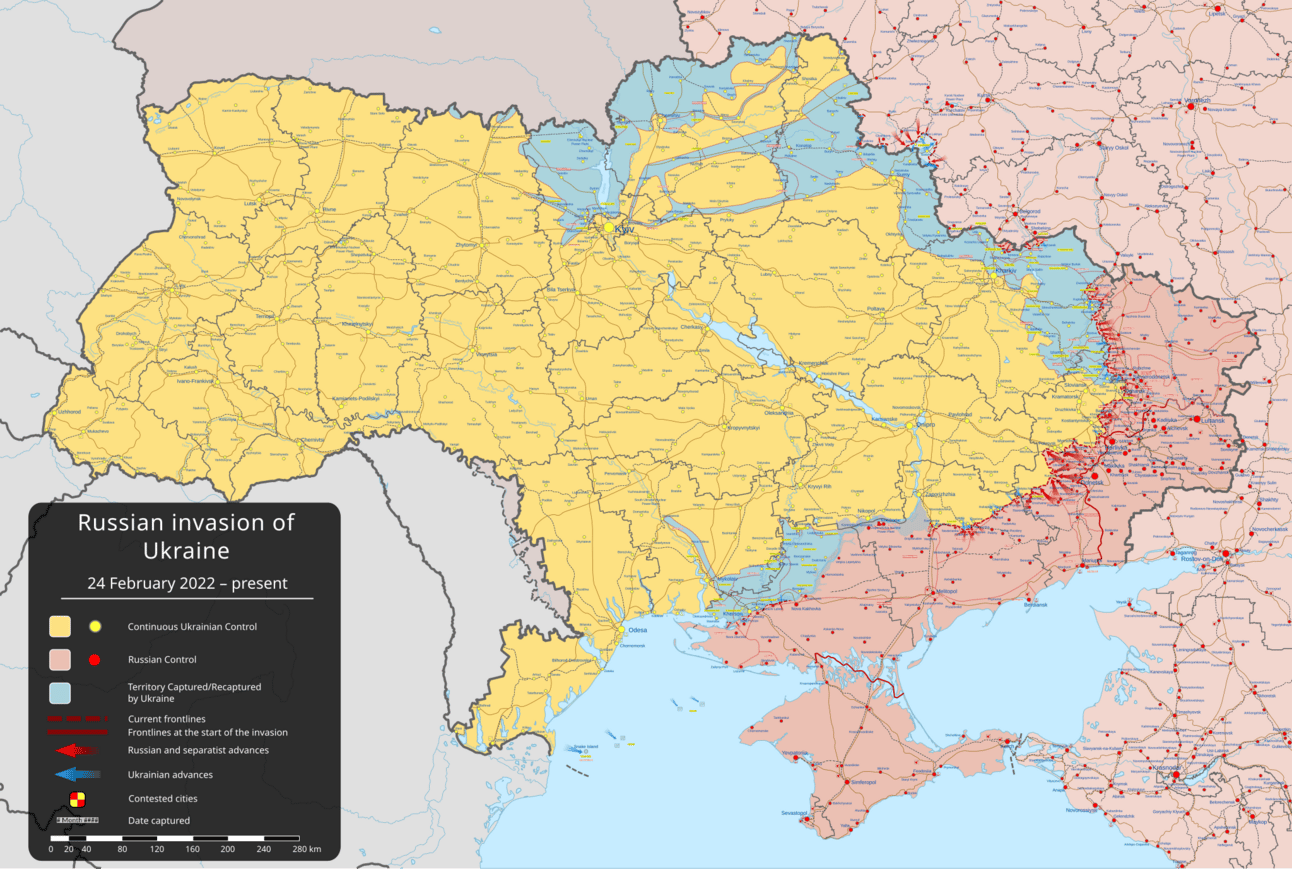
Map of Ukraine, as of 5 February 2025. Image credit: Viewsridge, CC BY-SA 4.0 https://creativecommons.org/licenses/by-sa/4.0, via Wikimedia Commons.
Aftermath
The invasion, the largest and deadliest conflict in Europe since World War II, caused hundreds of thousands of military casualties and tens of thousands of Ukrainian civilian casualties. As of this writing, Russian troops occupy nearly 20% of sovereign Ukrainian territory.
On March 17, 2023, following an investigation of war crimes, crimes against humanity and genocide, the International Criminal Court (ICC) issued arrest warrants for Vladimir Putin and Maria Lvova-Belova, the Russian commissioner for children’s rights. The ICC found the pair responsible for the war crime of unlawful deportation and transfer of children during the War.
Top Russian and US officials held talks in Saudi Arabia last week to discuss a potential end to the conflict. Ukraine and its European Allies were notably absent from the table. The move surprised many pundits and critics, who fear for the future of the NATO Alliance and US-European relations.
Lessons learned from the Russian invasion of Ukraine continue to influence military transformations across the world, as nations cope with the prospect of future large scale combat operations across multiple domains of war.
Regardless of how it ends, the Russian invasion of Ukraine continues to serve as a modern-day reminder of the atrocities of war, including the physical and mental toll it takes on military service members and innocent civilians.
Hey, thanks for reading! If you enjoy my content, I encourage you to become a free subscriber. I plan to post new articles nearly every day, delivered right to your inbox.
“The views and opinions presented herein are those of the author and do not necessarily represent the views of DoD or the US Army. The appearance of external hyperlinks does not constitute DoD or Army endorsement of the linked websites, or the information, products or services therein.”
Reply